The Future Homes Standard (FHS) is now published. If you're developing in London, here's what changes at feasibility stage.
Apr 3, 2026
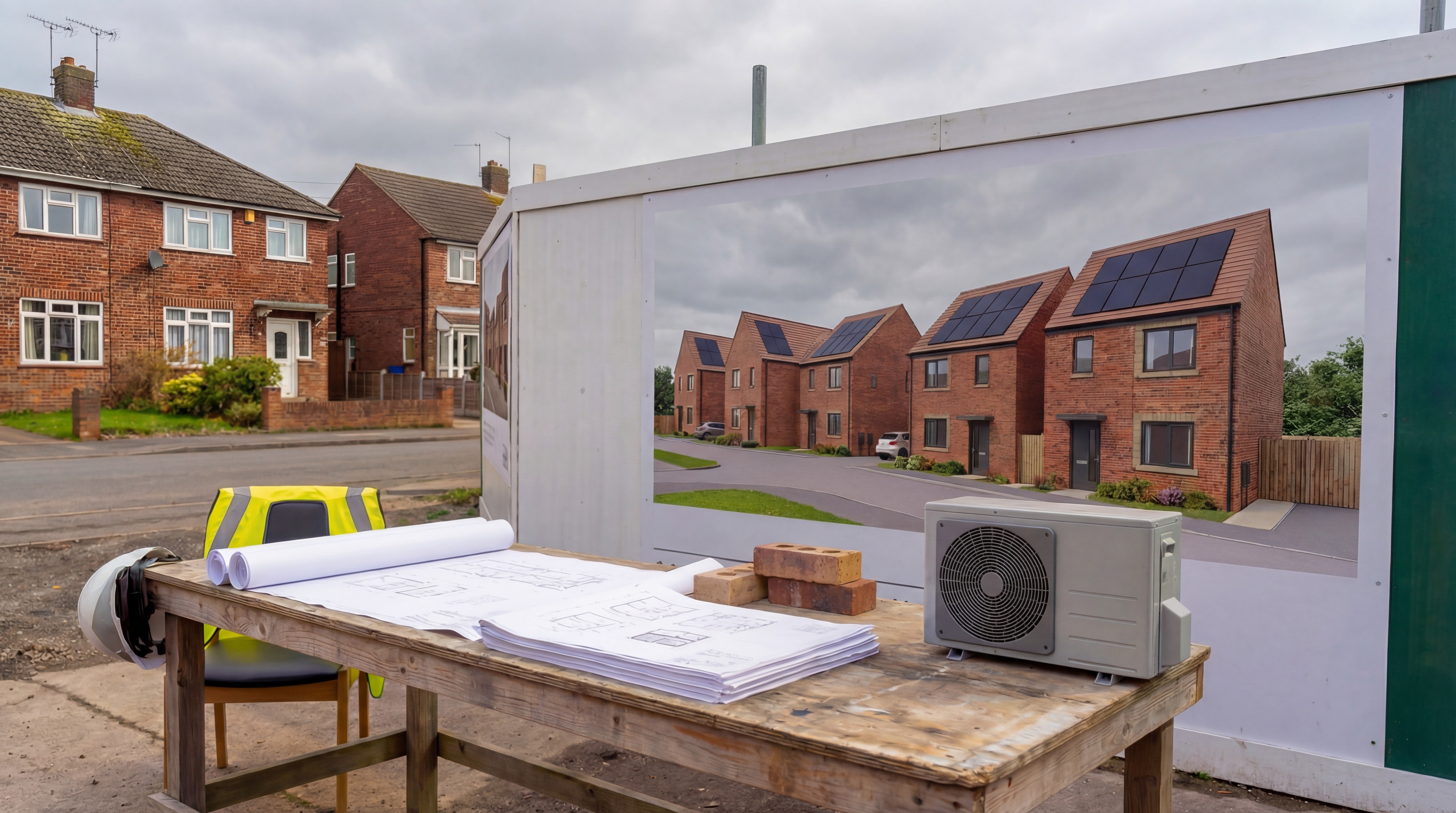
On 24 March 2026, the government published the final Future Homes and Buildings Standard, with the regulations set to come into force on 24 March 2027. A 12 month transition period will apply, which means schemes with planning applications submitted before that date may still proceed under Part L 2021, provided they are commenced within the permitted window. After March 2028, every new home in England will need to comply with the new standard.
The headline changes are considerable, and they go well beyond a routine regulatory update. New homes must achieve a 75% reduction in carbon emissions against the 2013 baseline, with heat pumps replacing gas boilers and solar panels becoming a functional requirement at a scale equivalent to around 40% of each dwelling’s ground floor area. Fabric standards are also tightening, with walls expected to reach 0.18 W/m²K or lower, while roofs and floors move to 0.13.
For volume housebuilders with in house technical teams, procurement structures, and experience trialling similar systems since 2021, this is a difficult but largely manageable transition. For SME developers delivering 3 to 25 units, the position is more exposed and far less forgiving. Recent survey data from the Home Builders Federation shows that 70% of SME builders say market conditions are already limiting their ability to start new sites, while 57% identify viability pressure as a major barrier. The National Federation of Builders has also warned that the impact assessment leaned too heavily on assumptions drawn from volume housebuilders, even though smaller firms are the ones more likely to carry the sharper cost burden.
Build costs are expected to rise by around 3 to 8%, while grid connections for heat pumps and solar are already creating delay and uncertainty. At the same time, the Home Energy Model is not yet fully approved, leaving SAP 10.3 in place as an interim tool. None of this alters the standard itself, but it does raise the cost of getting early assumptions wrong when projects are still being tested and shaped.
That is the point that matters most for anyone commissioning, funding, or assessing a scheme today, because the Future Homes Standard does not just change what gets built, it changes what needs to be understood before design has even begun. A feasibility study that does not account for fabric performance targets, heating strategy, solar provision, and the likely carbon trajectory of a scheme is no longer a serious test of viability. It is simply a concept wrapped in numbers, without enough technical depth to support reliable decision making.
This is even more important in conversions and change of use projects, which make up a large share of London’s SME development market, where existing fabric, structural limitations, servicing constraints, and conservation requirements all interact with performance targets in ways that have to be tested early. The real issue is not whether more consultants are added to the process, but whether the sequence of decisions is right from the start. The developers who will manage this transition well are the ones who treat sustainability, energy, and performance as feasibility questions before design commitment is made, rather than compliance matters to be dealt with after the scheme is already taking shape.
I. Attie , Attie & Partners — design, sustainability, and early-stage advisory for the built environment.